From Local Communities to Global Conversations: My Commonwealth Chemistry Poster Experience
Written by Kanayo Samuel Okonji
Participating in the 6th Commonwealth Chemistry Posters event was both an exciting and deeply meaningful experience for me as an early-career researcher working in environmental chemistry and public health-related research in Nigeria.
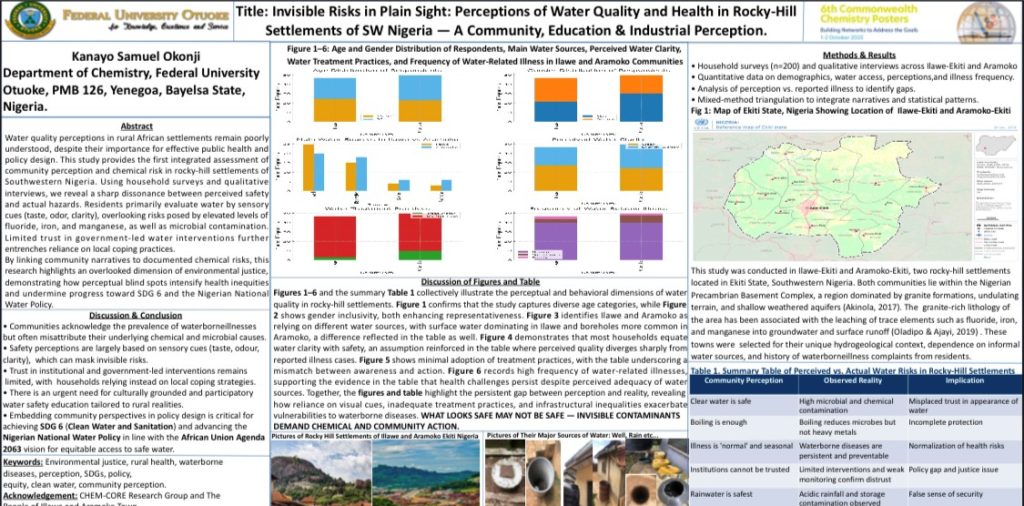
My poster, titled “Invisible Risks in Plain Sight: Perceptions of Water Quality and Health in Rocky-Hill Settlements of SW Nigeria — A Community, Education & Industrial Perception,” focused on how local communities perceive water quality and waterborne health risks in underserved rocky-hill settlements in Southwestern Nigeria. The study explored the intersection between environmental conditions, public health awareness, community experiences, and sustainable development challenges in rural communities where access to safe water remains limited.
The opportunity to present this work through the 6th Commonwealth Chemistry Posters event allowed me to share research from a local Nigerian context with an international scientific audience across the Commonwealth. One of the most inspiring aspects of the event was seeing how chemistry can connect researchers from different countries around common global challenges such as water safety, environmental sustainability, health, and education.
I was honoured that the poster was selected as the winning entry in the Community, Education and Industry category. Receiving this recognition from Commonwealth Chemistry and researchers involved in the judging process was highly encouraging and reinforced the importance of community-focused environmental research.
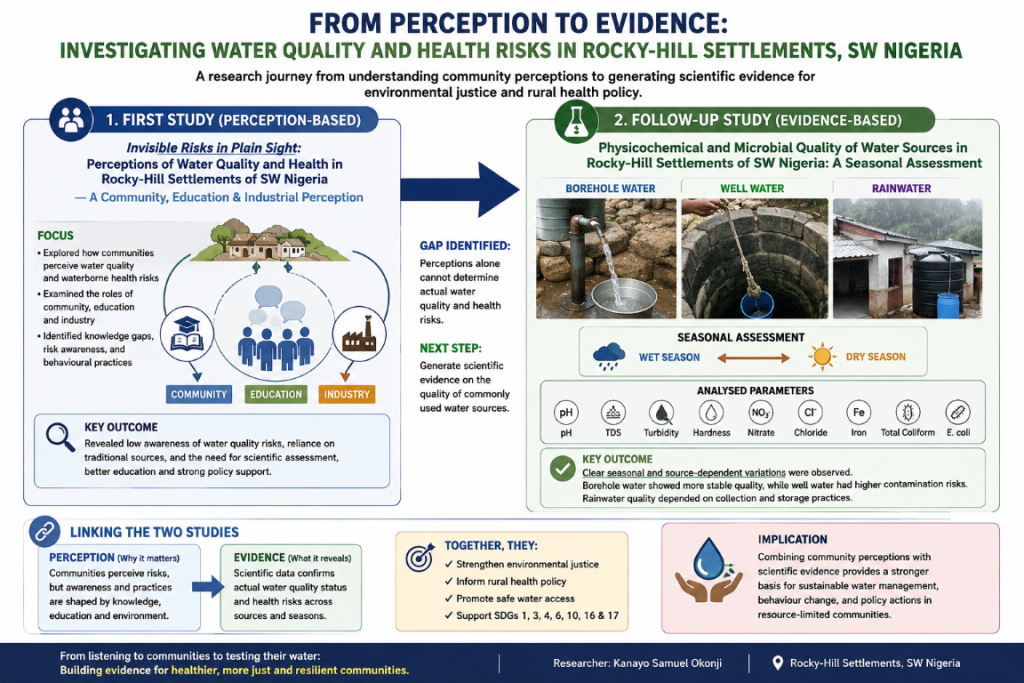
Beyond the award itself, the experience motivated me to continue the research . We used the prize support, alongside additional personal contributions, to carry out expanded investigations into water quality in rocky-hill settlements of Southwestern Nigeria.
Subsequent research
The follow-up study evaluated physicochemical and microbial characteristics of borehole water, well water, and rainwater sources during both wet and dry seasons. Using standard analytical methods, we assessed important water quality parameters and observed clear seasonal and source-dependent variations. Borehole water generally showed more stable quality, while well water demonstrated higher contamination risks. Rainwater quality also varied depending on collection and storage practices.
These findings highlighted important environmental and public health concerns for resource-limited communities and emphasized the urgent need for improved water management, monitoring, and treatment strategies. The research also demonstrated how environmental chemistry can contribute directly to sustainable development goals related to clean water, health, and community wellbeing.
The work presented at the Commonwealth Chemistry Posters event later developed into a peer-reviewed publication titled “Community Perception of Waterborne Health Risks in Rocky-Hill Settlements of Nigeria: Implications for Environmental Justice and Rural Health Policy in Sub-Saharan Africa.” This was subsequently published in the Ethiopian Journal of Environmental Studies and Management (EJESM).

Seeing the project progress from conference presentation to published research was particularly rewarding and reflected the value of scientific collaboration and research visibility initiatives such as Commonwealth Chemistry Posters.
As a researcher from Nigeria, participating in this event reminded me that locally grounded research can contribute meaningfully to global scientific discussions. Environmental challenges experienced by rural communities are often interconnected across countries, and platforms like Commonwealth Chemistry help create opportunities for researchers to learn from one another while building collaborative networks.
I remain sincerely grateful to Commonwealth Chemistry for my Commonwealth Chemistry poster experience, providing a platform that supports early-career researchers and promotes scientific engagement across the Commonwealth. The recognition and encouragement I received through the poster event have both strengthened my commitment to environmental chemistry research that addresses real-world public health and sustainability challenges.
Learn about our other prize-winners from our annual Commonwealth Chemistry Posters events